Showing posts with label does. Show all posts

Tuesday, March 21, 2017

Why An Iron Ship Does Not Sink


Why An Iron Ship Does Not Sink


                If you put a nail or a lump of iron in a vessel of water it sinks at once. A piece of wood of the same size floats. So, until fifty years or so ago, people thought all boats and ships must be built of wood, or they would sink.
              Take a sheet-iron pan from the kitchen and put that on the water. It floats. It weighs just as much as the lump of iron that sinks, but the weight is spread or distributed over a larger volume of water That is all. It has been made lighter than the total amount of water it rests upon. A ship is just such a hollow vessel, whether made of iron or wood. When there is nothing in it, a ship stands high, almost on the surface of the water. As it is loaded with goods and people, it rides deeper. Load your sheet iron pan with a cargo of toys. Watch it go deeper. Dont fill it to the top. That would make it as heavy as if it were solid. Then it would sink.
            If you live in a lake or sea-port town, you will find that all ships have a water-line painted plainly around the hull. This is the safety loading line. No ship owners are allowed to load a vessel so heavily that that water line sinks below the surface of the water. Air spaces must be left, to keep the ship and its cargo lighter than the water that is beneath them. In the old days overloaded wooden vessels often sank. Today, iron ships ride the ocean safely.

Source: http://chestofbooks.com/reference/The-New-Student-s-Reference-Work-Vol5/Why-An-Iron-Ship-Does-Not-Sink.html#.ViIG-fkrLIU#ixzz3ooQryes9


Available link for download


Read more »

Thursday, February 23, 2017

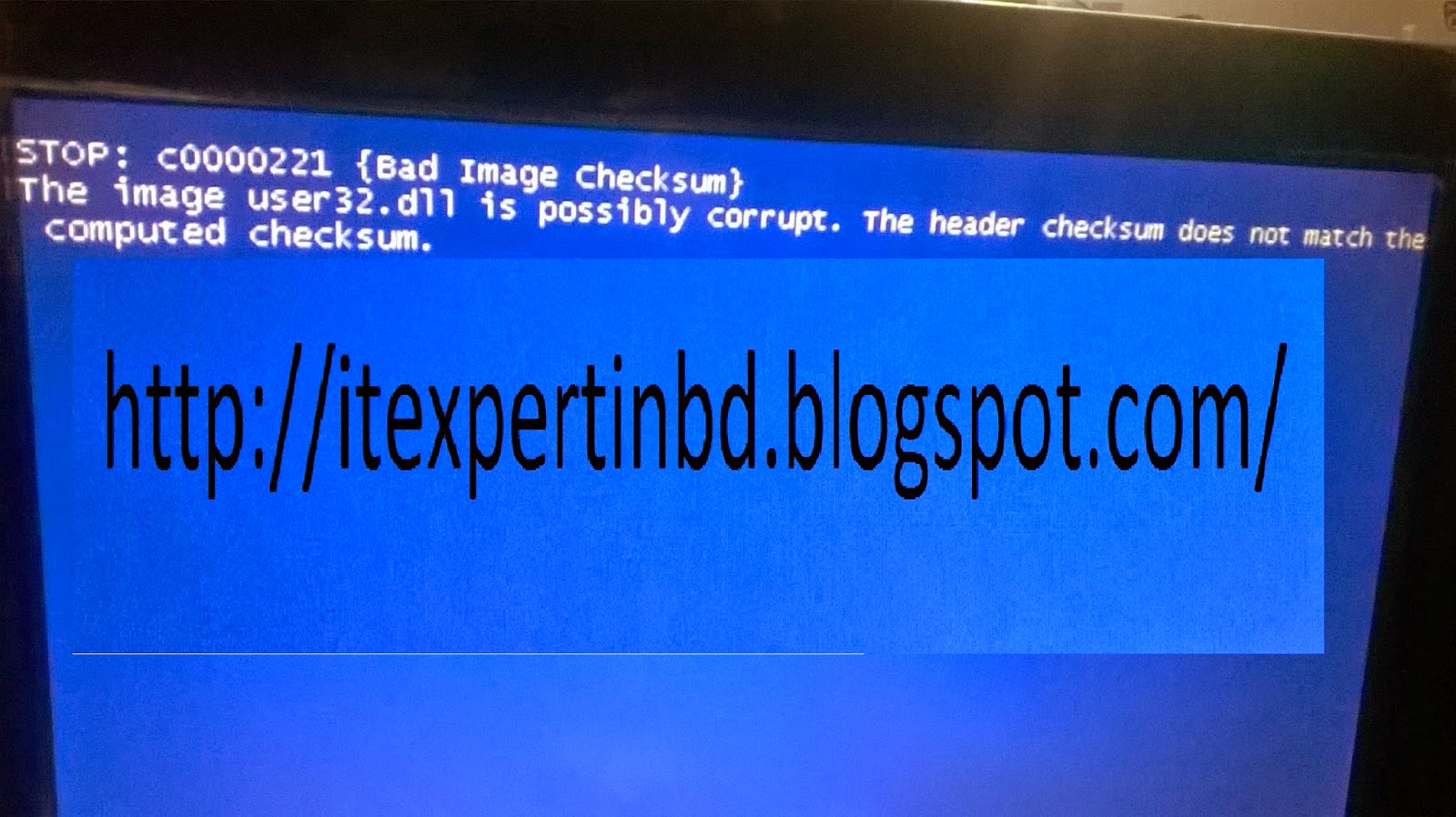
How to fix stop c0000221 bad image checksum the image user32 dll is possible corrupt the header checksum does not match the computed checksum


How to fix stop c0000221 bad image checksum the image user32 dll is possible corrupt the header checksum does not match the computed checksum


Stop: c0000221 {bad image checksum}

the image user32.dll is possible corrupt. the header checksum does not match the computed checksum.


How to Fix error code stop:c0000221
Add caption
How to Fix error code  stop:c0000221

Method 1: Extract a New Copy of the User32.dll File from the Windows XP CD
Method 2: Remove or Replace the Faulty RAM


Method 3: Replace hard disk or fix hdd bad sectors.

"how to fix Error! STOP:C0000221", "how to solve Error! STOP:C0000221", "how to fix stop: c0000221 {bad image checksum}", "how to solve stop: c0000221 {bad image checksum}"

Available link for download


Read more »

Wednesday, January 25, 2017

Does Vtune for nVidia drops out from market


Does Vtune for nVidia drops out from market


[Last Updated Dec 27, 2012]
I have updated my graphics driver and when I try to update the Vtune overclocker; no newer version was found. All searches regarding Vtune results in vain instead it is redirected to Intel-Vtune always. Even the Palit Microsystems, Inc. stops distributing this tool since it is discontinued by the developer but a new tool was released naming ThunderMaster. It was such an disappointment to all nVidia Vtune users. Either way I have a backup of Vtune tool which saves my all work.

Download Vtune v7.21.0.0  [compatible for XP, Vista and 7]

ThunderMaster Vs Vtune:

Tools Used : ThunderMaster, Vtune
Platform: Windows 7 Ultimate 64bit
CPU: Intel Pentium D @ 3.00GHz
GPU: nVidia GeForce 8400GS 512MB DDR2
RAM: 1.5 GB Dual channel
HardDisk: Western Digital Caviar 160GB SATA

At the first, the Thunder Master overclocker tool gives only little information about the graphics chip whereas the Vtune overclocker gives all the information including graphics card, current monitor resolution, keyboard driver, USB driver and the computer. This is not an important factor now but anyhow it is an useful factor.


Secondly the most important factor is the overclocking procedure. Thunder Master tool has only two adjustments; one for graphics clock with negative and positive values; another for memory clock with negative and positive values. I dont know why they are giving this negative values for overclocking may be it is for underclocking the GPU speed.

If this is meant for OverClocking

What for this zero values? (Reset or Neutral)

What for this negative values will do? (Underclocking)

Also ThunderMaster lacks the adjustment for shader clock settings whereas the Vtune has all the three adjustments with safe mode settings.

Overclock settings

Safe Mode or default clock Settings

Factory Settings (Minimum and Maximum values are fixed)

In actual, the minimum and maximum clock value settings are fixed for the graphics cards while manufacturing itself. So that we can tweak in-between values for overclocking and underclocking while running multimedia applications, games etc which needs high parallel processing power. But the options given in Thunder Master is unacceptable negative values that cannot be tweaked which may results in a hardware failure in future. Since both overclocking tools were tested on same graphics card with same platform, choosing the right tool is necessary in this case for the graphics card life.


Available link for download


Read more »

Sunday, December 25, 2016

What Is A QR Code And How Does It Work


What Is A QR Code And How Does It Work


                By now, you’re probably pretty familiar with QR codes (a.k.a. 2-D bar codes), whether or not you realize it. They’re the little square symbols that look like this:
                                                                  qr-code-01
The cool part is that anyone can make them. Yes, that includes you. Just Google “QR code generator” and you’ll have a plethora of websites that make it incredibly easy to make your own QR code. But that’s not even the best part. Once you have a QR code, you can mix things up, add color and graphics, and so much more. The key is to know how to keep your code scan-able.
Some people have already cracked this code, like Marc Jacobs. Others, like Yellow Pages, still have some homework to do. So how can you tell which edits will ruin your code and which ones will still allow it to be scanned? The question you should be asking is “what can’t I edit?”

The “No-Zones”

QR codes are made up of black squares and white squares. Each of these squares is called a module. In every QR code, there are certain modules that must not be covered or edited, else the code won’t scan. Here, they are all highlighted in different colors:
                                                 qr-code-02
  • The three large squares highlighted in red are the position markers. These tell the scanner where the edges of the code are.
  • The smaller red square is an alignment marker. This acts as a reference point for the scanner, making sure everything lines up properly. In bigger codes, there are several of these squares.
  • The red strips of alternating black and white modules are called timing patterns. They define the positioning of the rows and columns.
  • The green sections determine the format. This tells the scanner whether it’s a website, text message, Chinese symbols, numbers, or any combination of these.
  • The modules highlighted in blue represent the version number. Basically, the more modules in the code, the higher the version (up to v40, which is 177×177 modules). If the code is version 6 or smaller, the version does not need to be defined here because the scanner can literally count the modules and determine the version on its own.

Everything Else

So now that you know what you can’t edit, that means everything else is free game, right? Almost. All the remaining modules are grouped into sections of 8 modules. These groups (which I will call “bytes” from now on) fit together in the gray area like a jigsaw puzzle:
                                         qr-code-03
Now, when a smartphone or scanner reads a QR code, each byte is determined to be either completely readable or completely un-readable. That means that if you change one single module (e.g. turning a black square into a white square), the entire byte containing that module is rendered un-readable. At first, that sounds like a bad thing, but it actually makes things a lot easier. More on that in a second.

The Really Cool Part

In the Marc Jacobs code I linked to earlier, there was a sketch of a small girl covering part of the code. In spite of the fact that some of the code is covered up, it is still fully scan-able. This is because of the Reed Solomon error correction method. Basically, all QR codes are created with built-in error correction algorithms that allow them to be scanned even if a few bytes are missing/covered/replaced by a picture of your cat. The larger the version, the more bytes you can edit.
You can use the Version and Maximum Data Capacity Table on Denso-Wave’s website to determine exactly how many bytes you can turn into awesome graphic art. You need to know the version of your code (also found in the version table), and how many characters the message contains (i.e. if your code is built from the website “http://www.your-awesome-website.com”, that would be 35 characters).
The table will give you a letter that represents the level of error-correction contained in your code. Here’s what these letters mean:
  • Level L – You can alter up to 7% of the code without ruining its scan-ability. If your code has 154 bytes, you can edit 10 (maybe 11) bytes and it will still scan successfully.
  • Level M – You can alter up to 15% of the code.
  • Level Q – You can alter up to 25% of the code.
  • Level H – You can alter as much as 30% of your code.
So now you should be able to do the following:
–          Generate a QR code
–          Identify the No-Zones
–          Figure out the placement of the bytes
–          Figure out how many bytes you can edit
Now that you know just about everything involved in creating and understanding a QR code, let’s dive into how to turn it into a unique piece of graphic (or even hand-drawn) art.

Ready, Set…

At this point, it all comes down to asking yourself “what if,” and then finding the answer to that question. Look at your QR code, figure out which bytes you want to try to change, and then change them. Scan it to see if it still works. If it still works, make another change. If not, go back and figure out why. I’ll show you an example of what this process might look like.
I started out with a regular QR code, isolated which bytes I wanted to play around with, and outlined them in red (top left). First, I just scrambled all the modules within the red border (top right). It still scanned. Then, I took out all the modules completely (bottom left). It still scanned. Lastly, I filled the red border with a portrait of one of the most influential aliens from my childhood.
       qr-code-04

…Go!

It’s a matter of experimentation. Think of an idea, try it and scan it. Then work from there. Go online and look for other creative QR code graphic art, to see what boundaries other people are pushing. Pretty soon, you’ll end up doing something like this:
       qr-code-infographic

Resources:

http://www.ucreative.com/articles/what-is-a-qr-code-and-how-does-it-work/   
 http://www.systemid.com/qrcode/
http://www.denso-wave.com/qrcode/qrgene2-e.html
Available link for download


Read more »

Tuesday, December 20, 2016

Does Bitrate Really Make a Difference In My Music


Does Bitrate Really Make a Difference In My Music


Does Bitrate Really Make a Difference In My Music?

Does Bitrate Really Make a Difference In My Music?

What Is Bitrate?

Youve probably heard the term "bitrate" before, and you probably have a general idea of what it means, but just as a refresher, its probably a good idea to get acquainted with its official definition so you know how all this stuff works. Bitrate refers to the number of bits—or the amount of data—that are processed over a certain amount of time. In audio, this usually means kilobits per second. For example, the music you buy on iTunes is 256 kilobits per second, meaning there are 256 kilobits of data stored in every second of a song.
Does Bitrate Really Make a Difference In My Music?
The higher the bitrate of a track, the more space it will take up on your computer. Generally, an audio CD will actually take up quite a bit of space, which is why its become common practice to compress those files down so you can fit more on your hard drive (or iPod, or Dropbox, or whatever). It is here where the argument over "lossless" and "lossy" audio comes in.

Lossless and Lossy Formats

When we say "lossless", we mean that we havent really altered the original file. That is, weve ripped a track from a CD to our hard drive, but havent compressed it to the point where weve lost any data. It is, for all intents and purposes, the same as the original CD track.
More often than not, however, you probably rip your music as "lossy". That is, youve taken a CD, ripped it to your hard drive, and compressed the tracks down so they dont take up as much space. A typical MP3 or AAC album probably takes up 100MB or so. That same album in lossless format, though—such as FLAC or ALAC (also known as Apple Lossless) would take up closer to 300MB, so its become common practice to use lossy formats for faster downloading and more hard drive savings.
The problem is that when you compress a file to save space, youre deleting chunks of data. Just like when you take a PNG screenshot of your computer screen, and compress it to a JPEG, your computer is taking the original data and "cheating" on certain parts of the image, making itmostly the same but with some loss of clarity and quality. Take the two images below as an example: the one on the right has clearly been compressed, and its quality has diminished as a result. (Youll probably want to expand the image for a closer look to see the differences—look at the foxs ears and nose).
Does Bitrate Really Make a Difference In My Music?
Remember, of course, that youre still reaping the benefits of hard drive space with lossy music (which can make a big difference on a 32 GB iPhone), its just the tradeoff you make. There are different levels of lossiness, as well: 128kbps, for example, takes up very little space, but will also be lower quality than a larger 320kbps file, which is lower quality than an even larger 1,411 kbps file (which is considered lossless). However, theres a lot of argument as to whether most people can even hear the difference between different bitrates.

Does It Really Matter?

Since storage has become so cheap, listening to higher-bitrate audio is starting to become a more popular (and practical) practice. But is it worth the time, effort, and space? I always hate answering questions this way, but unfortunately the answer is: it depends.
Does Bitrate Really Make a Difference In My Music?
Part of the equation is the gear you use. If youre using a quality pair of headphones or speakers, youre privy to a large range of sound. As such, youre more likely to notice certain imperfections that come with compressing music into lower bitrate files. You may notice that a certain level of detail is missing in low-quality MP3s; subtle background tracks might be more difficult to hear, the highs and lows wont be as dynamic, or you might just plain hear a bit of distortion. In these cases, you might want to get a higher bitrate track.

Available link for download


Read more »