Showing posts with label we. Show all posts
Showing posts with label we. Show all posts
Monday, January 9, 2017
Why we use Zero Ohm Resister
Why we use Zero Ohm Resister
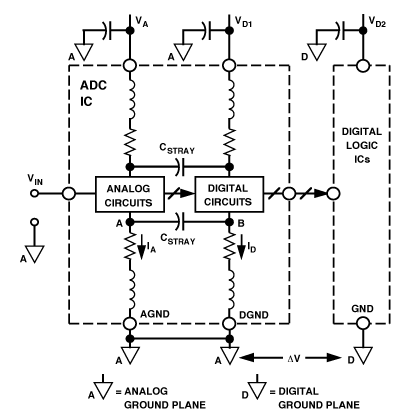
In a mixed signal system its recommended to join AGND and DGND close to the mixed-signal IC, often the one performing the A-D function. The reason for this is to reduce differential noise in the mixed-signal IC. See the diagram below. The objective of minimising noise coupling from B to A is aided by joining the GNDs on a low-impedance ground plane. In a system with both an AGND plane and a DGND plane it is common to connect both the planes at this point with a link to minimise differential voltages. Sometimes this link is a wire with a ferrite bead, sometimes its a zero-ohm resistor or even just a narrow PCB trace.
See a good description here.
As for the Zero Ohm resistor. Think of it as a link that is easily placed by a pick and place machine during manufacture and also easily removable for experimentation on prototypes, if required. Because its a physical component, the ground plane connection is easily identifiable in PCB design tools which makes it easier for the designer and layout engineers to communicate intent.
Available link for download

Tuesday, December 6, 2016
Why do we use a diac for triggering a triac
Why do we use a diac for triggering a triac
Why do we use a diac for triggering a triac?

Available link for download
Subscribe to:
Posts (Atom)