Showing posts with label current. Show all posts
Showing posts with label current. Show all posts
Wednesday, March 15, 2017
What is Quiescent Current
What is Quiescent Current
The term given to describe the amount of current consumed by a circuit when it is not performing any work (sometimes referred to as standby current). This is a particularly important concept in designing battery-operated systems such as wireless beltpack transmitters. Battery life is determined by the total current drain composed of quiescent current and load current. Usually battery-operated devices are in standby mode more than in operation mode so the quiescent current consumption is the more dominant consideration. Quiescent current consumption should be as low as possible in order to prolong the battery’s life.
Class A amplifiers have the general property that the output device(s) always carry a significant current level, and hence have a large quiescent current. The quiescent current is defined as the current level in the amplifier when it is producing an output of zero. Class A amplifiers vary the large quiescent current in order to generate a varying current in the load, hence they are always inefficient in power terms.
Source: http://www.sweetwater.com/insync/class/
Available link for download

Sunday, February 19, 2017
What is a constant power load Constant current load and Constant resistance load
What is a constant power load Constant current load and Constant resistance load
Constant resistance load:
In a constant resistance load the current will go down in proportion to the voltage drop as the resistance is fixed and the load must follow ohms law. Heaters approximate this type of load.
Constant current load:
In a constant current load the load will dynamically adjust its resistance as the voltage drops to keep the current constant. Thus as the battery voltage drops so will the equivalent resistance of the load. Older linear regulators using a pass transistor to deliver constant voltage to a fixed load powering electronics are this kind of load.
Constant power load:
In a constant power load, the dynamic resistance is adjusted to increase the current inversely to the load voltage. as the voltage rises or falls, then the product of voltage and current in the load is power which is constant. This is done to keep the power dissipated in the load constant as the voltage drops. Electronics devices with SMPS approximate this type of load as they generally employ regulators to generate a constant voltage and when then runs the electronics.
Real loads usually approximate one of the three types of load. Electrical engineers have as one of their tools electronics loads which can be programmed to emulate the load types above.
Source : Quora
In a constant resistance load the current will go down in proportion to the voltage drop as the resistance is fixed and the load must follow ohms law. Heaters approximate this type of load.
Constant current load:
In a constant current load the load will dynamically adjust its resistance as the voltage drops to keep the current constant. Thus as the battery voltage drops so will the equivalent resistance of the load. Older linear regulators using a pass transistor to deliver constant voltage to a fixed load powering electronics are this kind of load.
Constant power load:
In a constant power load, the dynamic resistance is adjusted to increase the current inversely to the load voltage. as the voltage rises or falls, then the product of voltage and current in the load is power which is constant. This is done to keep the power dissipated in the load constant as the voltage drops. Electronics devices with SMPS approximate this type of load as they generally employ regulators to generate a constant voltage and when then runs the electronics.
Real loads usually approximate one of the three types of load. Electrical engineers have as one of their tools electronics loads which can be programmed to emulate the load types above.
Source : Quora
Available link for download
Sunday, December 25, 2016
Change Window 7 Password Without Knowing Current Password
Change Window 7 Password Without Knowing Current Password
Change Window 7 Password Without Knowing Current Password
More Tricks
- Save you Facebook ID from Hackers
- Very Basic Batch Tutorials
- Increase Facebook Followers Via List Exchange Trick
- How to Lock a Folder in Windows 7/8/8.1
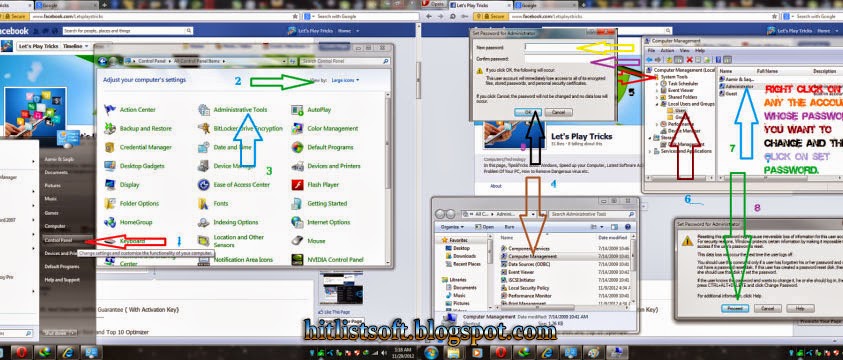
Go to Control Panel and click on the Administrative Tools
Step 2 :
Under this section double click on Computer Management.
Select System Tools from right window pane.
Step 3 :
Under this, just double clickon Local Users and Groups and then on Users
Step 4 :
Now you will see all the login accounts of your computer.
Step 5:
.Right click on any the account whose password you want to change and then click on Set Password.
Step 6 :
A warning message will popup on your screen just click on Proceed button.
Step 7 :
Now enter your New Password and click on OK button.
Enjoy...........
Available link for download
Subscribe to:
Posts (Atom)