Showing posts with label capacitors. Show all posts
Showing posts with label capacitors. Show all posts
Tuesday, January 17, 2017
Whether Tantalum capacitors are safe for use in new designs
Whether Tantalum capacitors are safe for use in new designs
The answer is "When you used properly". Tantalum capacitors are highly reliable.
They have the advantage of high capacitance per volume and good decoupling characteristics due to relatively low internal resistance and low inductance compared to traditional alternatives such as aluminum wet electrolytic capacitors.
They have the advantage of high capacitance per volume and good decoupling characteristics due to relatively low internal resistance and low inductance compared to traditional alternatives such as aluminum wet electrolytic capacitors.
The catch is in the qualifier "when used properly".Tantalum capacitors have a failure mode which can be triggered by voltage spikes only slightly more than their rated value. When used in circuits that can provide substantial energy to the capacitor failure can lead to thermal run-away with flame and explosion of the capacitor and low resistance short-circuiting of the capacitor terminals.
To be "safe" the circuits they are used in need to be guaranteed to have been rigorously designed and the design assumptions need to be met.This does not always happen.Tantalum capacitors are safe enough in the hands of genuine experts, or in undemanding circuits, and their advantages make them attractive. Alternatives such as "solid aluminum" capacitors have similar advantages and lack the catastrophic failure mode.
Many modern tantalum capacitors have built in protection mechanisms which implement fusing of various sorts, which is designed to disconnect the capacitor from its terminals when it fails and to limit pcb charring in most cases.
If when, limit and most are acceptable design criteria and/or you are a design expert and your factory always gets everything right and your application environment is always well understood, then tantalum capacitors may be a good choice for you.
If when, limit and most are acceptable design criteria and/or you are a design expert and your factory always gets everything right and your application environment is always well understood, then tantalum capacitors may be a good choice for you.
Source : electronics.stackexchange.com
Available link for download

Friday, November 4, 2016
Bad capacitors How to spot them
Bad capacitors How to spot them
Bad capacitors :
How to spot them
A bad capacitor or one that is starting to bulge will start to swell at the top, no longer looking indented
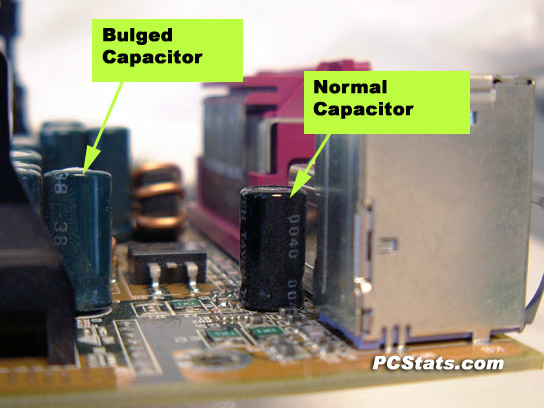
Others swell to the point of blowing thus you can see electrolyte brown crud on the top of the capacitors.

Others Leak

In any case once you start to see the following symptoms its time to either replace the motherboard, replace the computer, or know that the issue is not going away


Available link for download
Wednesday, October 12, 2016
Subscribe to:
Posts (Atom)