Showing posts with label types. Show all posts
Showing posts with label types. Show all posts
Tuesday, December 27, 2016
Types of IC Pakages
Types of IC Pakages
IC Packages
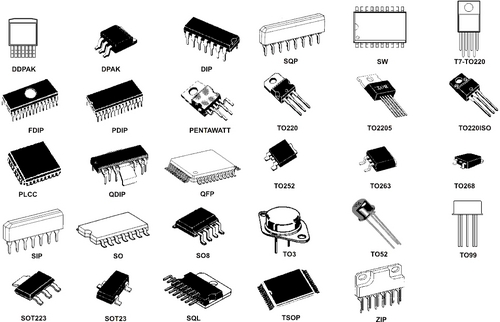
The package is what encapsulates the integrated circuit die and splays it out into a device we can more easily connect to. Each outer connection on the die is connected via a tiny piece of gold wire to a pad or pin on the package. Pins are the silver, extruding terminals on an IC, which go on to connect to other parts of a circuit. These are of utmost importance to us, because they’re what will go on to connect to the rest of the components and wires in a circuit.There are many different types of packages, each of which has unique dimensions, mounting-types, and/or pin-counts.
Polarity Marking and Pin Numbering
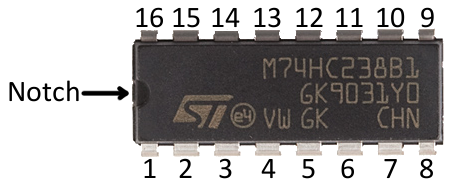
All ICs are polarized, and every pin is unique in terms of both location and function. This means the package has to have some way to convey which pin is which. Most ICs will use either a notch or a dot to indicate which pin is the first pin. (Sometimes both, sometimes one or the other.)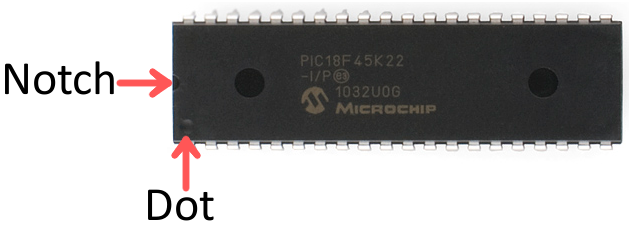
Mounting Style
One of the main distinguishing package type characteristics is the way they mount to a circuit board. All packages fall into one of two mounting types: through-hole (PTH) or surface-mount (SMD or SMT). Through-hole packages are generally bigger, and much easier to work with. They’re designed to be stuck through one side of a board and soldered to the other side.Surface-mount packages range in size from small to minuscule. They are all designed to sit on one side of a circuit board and be soldered to the surface. The pins of a SMD package either extrude out the side, perpendicular to the chip, or are sometimes arranged in a matrix on the bottom of the chip. ICs in this form factor are not very “hand-assembly-friendly.” They usually require special tools to aid in the process.
DIP (Dual in-line packages)
DIP, short for dual in-line package, is the most common through-hole IC package you’ll encounter. These little chips have two parallel rows of pins extending perpendicularly out of a rectangular, black, plastic housing.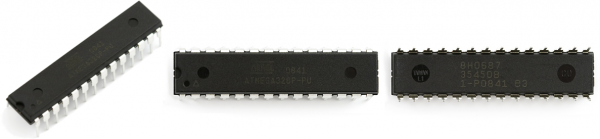
The 28-pin ATmega328 is one of the more popular DIP-packaged microcontrollers (thanks, Arduino!).
Each of the pins on a DIP IC are spaced by 0.1" (2.54mm), which is a standard spacing and perfect for fitting into breadboards and other prototyping boards. The overall dimensions of a DIP package depend on its pin count, which may be anywhere from four to 64.The area between each row of pins is perfectly spaced to allow DIP ICs to straddle the center area of a breadboard. This provides each of the pins its own row in the board, and it makes sure they don’t short to each other.
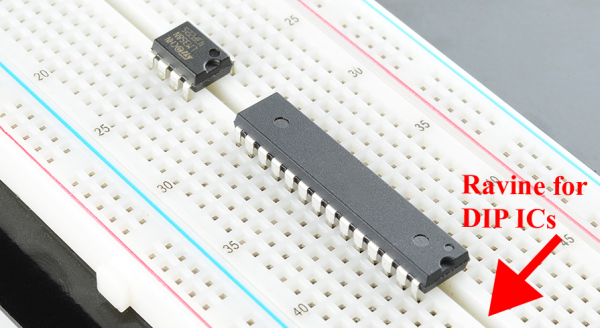
Aside from being used in breadboards, DIP ICs can also be soldered into PCBs. They’re inserted into one side of the board and soldered into place on the other side. Sometimes, instead of soldering directly to the IC, it’s a good idea to socket the chip. Using sockets allows for a DIP IC to be removed and swapped out, if it happens to “let its blue smoke out.”
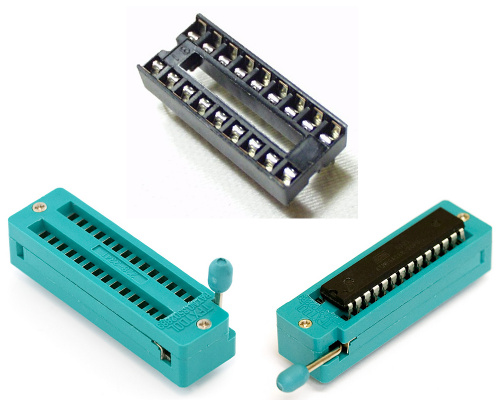
A regular DIP socket (top) and a ZIF socket with and without an IC.
Surface-Mount (SMD/SMT) Packages
There is a huge variety of surface-mount package types these days. In order to work with surface-mount packaged ICs, you usually need a custom printed circuit board (PCB) made for them, which has a matching pattern of copper on which they’re soldered.Here are a few of the more common SMD package types out there, ranging in hand-solderability from “doable” to “doable, but only with special tools” to “doable only with very special, usually automated tools”.
Small-Outline (SOP)
Small-outline IC (SOIC) packages are the surface-mount cousin of the DIP. It’s what you’d get if you bent all the pins on a DIP outward, and shrunk it down to size. With a steady hand, and a close eye, these packages are among the easiest SMD parts to hand solder. On SOIC packages, each pin is usually spaced by about 0.05" (1.27mm) from the next.The SSOP (shrink small-outline package) is an even smaller version of SOIC packages. Other, similar IC packages include TSOP (thin small-outline package) and TSSOP (thin-shrink small-outline package).
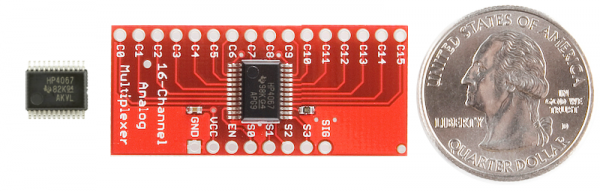
A 16-Channel Multiplexer (CD74HC4067) in a 24-pin SSOP package. Mounted on a board in the middle (quarter added for size-comparison).
A lot of the more simple, single-task-oriented ICs like the MAX232 or multiplexers come in SOIC or SSOP forms.Quad Flat Packages
Splaying IC pins out in all four directions gets you something that might look like a quad flat package (QFP). QFP ICs might have anywhere from eight pins per side (32 total) to upwards of seventy (300+ total). The pins on a QFP IC are usually spaced by anywhere from 0.4mm to 1mm. Smaller variants of the standard QFP package include thin (TQFP), very thin (VQFP), and low-profile (LQFP) packages.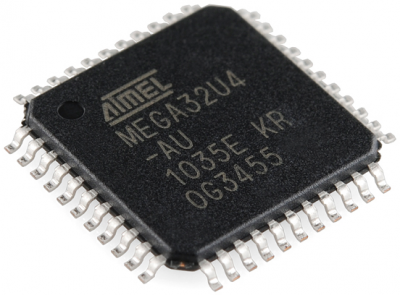
The ATmega32U4 in a 44-pin (11 on each side) TQFP package.
If you sanded the legs off a QFP IC, you get something that might look like a quad-flat no-leads (QFN) package. The connections on QFN packages are tiny, exposed pads on the bottom corner edges of the IC. Sometimes they wrap around, and are exposed on both the side and bottom, other packages only expose the pad on the bottom of the chip.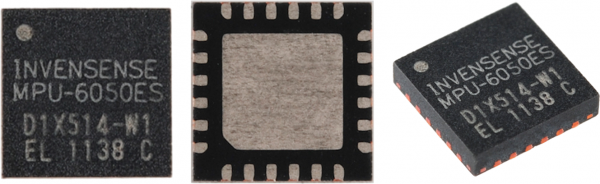
The multitalented MPU-6050 IMU sensor comes in a relatively tiny QFN package, with 24 total pins hiding on the bottom edge of the IC.
Thin (TQFN), very thin (VQFN), and micro-lead (MLF) packages are smaller variations of the standard QFN package. There are even dual no-lead (DFN) and thin-dual no-lead (TDFN) packages, which have pins on just two of the sides.Many microprocessors, sensors, and other modern ICs come in QFP or QFN packages. The popular ATmega328 microcontroller is offered in both a TQFP package and a QFN-type (MLF) form, while a tiny accelerometer/gyroscope like the MPU-6050 comes in a miniscule QFN form.
Ball Grid Arrays
Finally, for really advanced ICs, there are ball grid array (BGA) packages. These are amazingly intricate little packages where little balls of solder are arranged in a 2-D grid on the bottom of the IC. Sometimes the solder balls are attached directly to the die!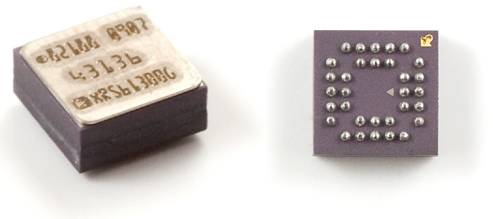
If you can hand solder a BGA-packaged IC, consider yourself a master solderer. Usually, to put these packages onto a PCB requires an automated procedure involving pick-and-place machines and reflow ovens
Source : Sparkfun
Available link for download

Wednesday, November 30, 2016
Friday, November 11, 2016
Saturday, October 1, 2016
Cloud Computing Types
Cloud Computing Types

Public
Public clouds are perhaps the most common type of this service out there and one that is most accessible and convenient for individual users, which is not to say that business can’t make great use of them. Any kind of cloud service that is offered from a single provider to numerous users, with hardware and software being owned by the provider can be considered a public cloud. In this kind of setup you are simply renting the services or resources, without having any kind of control over the platform itself. Public clouds can offer storage, web based applications, or a number of other services to their users, according to the one to many principle, which is to say all users are getting the same application, for instance, with the only difference being in their contract with the provider – a number of authorized users, limitations on application features and similar.Scalability of this kind of service, combined with the fact that users don’t have to own expensive hardware, make this setup extremely cost effective for businesses, but public cloud systems are still being plagued by chinks in their armor, which is to say security issues.
Private
Private cloud setups are mostly used by large corporations that require absolute control over their cloud, as well as an increased level of security. The corporation in question can decide to purchase the necessary hardware, or simply host their cloud with an external provider, but most prefer the former solutions, as the investment in hardware is more than justified by the additional increase in control that it affords. The cloud is only used by the corporation, and is completely isolated from other clouds, making it much more secure.Hybrid
As can be inferred from its name, hybrid clouds are a combination of a private cloud with a public one. This allows the user to have an adequate level of control and security, but also to use the resources of a public cloud. This affords for great flexibility, as you can always limit the integration of the two clouds to perfectly suit your needs. Just like private clouds, you do need expert IT staff capable of maintaining the private cloud and the link with the public one.Community
This term describes clusters of private clouds that remain separate on one level, but have a joint hub. This kind of setup is mostly used by related organizations that need access to the same kind of resources, but that have to stay separate. One of the examples of this kind of setup are different government organizations which need to be able to function individually, but which can also use a hub for the synchronization of their data and resources.
Image Credit: hin255
Image Credit: hin255
Author Bio:
Olivia Still is a blogger, technivore, cloud computing enthusiast, and online marketing consultant for a number of Australian companies. Currently exploring the possibilities of virtual private server.Available link for download
Subscribe to:
Posts (Atom)